tom witkowski
Developing with character
At Northland, Stewart specializes in preserving large tracts of land
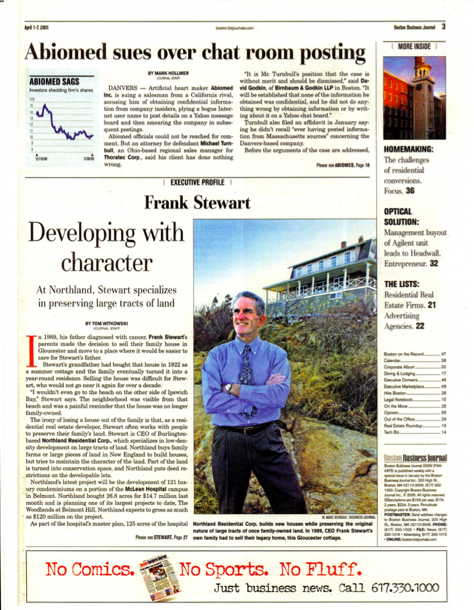
In 1989, his father diagnosed with cancer, Frank Stewart’s parents made the decision to sell their family house in Gloucester and move to a place where it would be easier to care for Stewart’s father.
Stewart’s grandfather had bought that house in 1922 as a summer cottage and the family eventually turned it into a year-round residence. Selling the house was difficult for Stewart, who would not go near it again for over a decade.
“I wouldn’t even go to the beach on the other side of Ipswich Bay,” Stewart says. The neighborhood was visible from that beach and was a painful reminder that the house was no longer family-owned.
The irony of losing a house out of the family is that, as a residential real estate developer, Stewart often works with people to preserve their family’s land. Stewart is CEO of Northland Residential Corp., which specializes in low-density development on large tracts of land. Northland buys family farms or large pieces of land in New England to build houses, but tries to maintain the character of the land. Part of the land is turned into conservation space, and Northland puts deed restrictions on the development lots.
Northland’s latest project will be the development of 121 luxury condominiums on a portion of the McLean Hospital campus in Belmont. Northland bought the 26.8 acres for $14.7 million last month and is planning one of its largest projects to date, The Woodlands at Belmont Hill. Northland expects to gross as much as $120 million on the project.
As part of the hospital’s master plan, 125 acres of the hospital campus will be dedicated as open space and two other developers will build a senior-housing complex and a R&D facility on smaller parcels of the campus.
“If you stand outside in that open space, it’s so hard to believe that you’re inside Route 128,” Stewart says. “It feels like you’re in Vermont or New Hampshire.”
Many of Northland’s previous projects have, in fact, been in Vermont and New Hampshire. The company was once part of Northland Investment Corp. of Newton, “an up-country land company” that bought land in northern New England. Stewart’s first job was at Northland as a land-use planner after studying forestry at the University of Maine. Stewart has worked nowhere else since.
“Our concept was, there were many people who valued the land and want to own 10 or 15 or 20 acres and enjoy the land or grow crops, rather than (own) little lots,” Northland founder Robert Danziger says. “It was a contrary corporate philosophy. It turned out to be a very successful business plan.”
That philosophy attracted Stewart to the company. In 1995 when Danziger retired, he sold the company to three employees, the heads of the company’s three divisions. The new owners split the divisions into three separate companies and, with the backing of private investors, Stewart became president and CEO of Northland Residential.
Danziger remains a director and investor in Stewart’s company. Stewart has maintained that original corporate philosophy, Danziger says.
“(The developments) still have that feel to them. There’s a lot of open space. He’s done everything in a way that is environmentally responsible, and people like that,” Danziger says.
Northland also has remained relatively small—15 employees—and did not balloon as the real estate market boomed.
“Growth has not been their No. 1 objective. It’s … to do projects they like and make a good profit at it,” says Peter Small, a director of Northland and a former president and CEO of real estate development firm Spaulding & Slye, now Spaulding & Slye Colliers.
“Frank is a genius at walking a piece of land and figuring out how it ought to be put together,” Small says.
The McLean project marks the first time Northland faced a major battle with project opponents. The hospital had started planning with the town for the sale of that land nine years ago. A group of residents fought the project, and Northland eventually agreed to pay $300,000 to the town to use for possible additional improvements, such as new sidewalks, new streets, a bicycle path and sewer improvements, and the project moved forward once more.
The opposition was unusual for a Northland project, Stewart says.
“Typically, we wear a white hat,” he says. “The real key is the believability of what we’re doing. Once people understand who we are and that we’ll do what we say, they reach a comfort level.”
In Carlisle, the developer is in a joint venture with the Carlisle Conservation Foundation. Northland will build eight houses on an 80-acre portion of the former Benfield Farm.
“The property in question has been No. 1 on the town’s list of priority parcels to preserve,” said Greg Peterson, a foundation director and partner at DLA Piper Rudnick Gray Cary US LLP.
The farm spans 170 acres and is the largest privately owned parcel of land in Carlisle. About 68 percent of the land will now be owned by the foundation, or have stringent deed restrictions placed on it. The owners of the land brought Northland into the deal, and after working out the details, Peterson calls Stewart “a boy scout.” “His head and his heart are both capable and in the right place.”
The Benfield Farm fits the profile of many of Northland’s projects, Stewart says. The land is a family legacy, but the family needs to realize some gain on the asset and not just donate it.
“Oftentimes, we can do something they’ll feel good about,” the developer says. “It’s rare to find people who will make a commitment to land they own and forgo a substantial piece of value to limit its development. I have a lot of respect for somebody who will do that.”
Through his own experience with his family house in Gloucester, Stewart understands personal connections to family land. Eleven years after his parents sold that house, Stewart finally took his mother on a Sunday drive in their old neighborhood. They saw an open-house sign at the corner. The people to whom the Stewarts sold the house had put it back on the market.
“I walked into the house. of course, you’re flooded with all the memories. I walked into the second-floor hall and the hair went up on the back of my neck. My grandfather and father were there. I could feel it,” he says.
Stewart made an offer; the house is once more in his family, enjoyed by his own three children and grandchildren.
Boston Business Journal, April 1-7, 2005