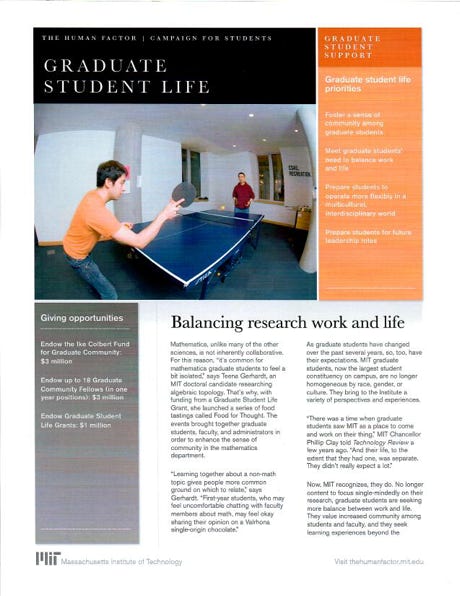
tom witkowski
Graduate student life
Balancing research work and life
Mathematics, unlike many of the other sciences, is not inherently collaborative. For this reason, “it’s common for mathematics graduate students to feel a bit isolated,” says Teena Gerhardt, and MIT doctoral candidate researching algebraic topology. That’s why, with funding from the Graduate Student Life grant, she launched a series of food tastings called Food for Thought. The events brought together graduate students, faculty, and administrators in order to enhance the sense of community in the mathematics department.
“Learning together about a non-math topic gives people more common ground on which to relate,” says Gerhardt. “First-year students, who may feel uncomfortable chatting with faculty members about math, may feel okay sharing their opinion on a Valrhona single-origin chocolate.
As graduate students have changed over the past several years, so, too, have they expectations. MIT graduate students, now the largest student constituency on campus, are no longer homogeneous by race, gender, or culture. They bring to the Institute a variety of perspectives and experiences.
“There was a time when graduate students saw MIT as a place to come and work on their thing,” MIT Chancellor Philip Clay told Technology Review, a few years ago. “And their life, to the extent that they had one, was separate. They didn’t really expect a lot.”
Now, MIT recognizes, they do. No longer content to focus single-mindedly on their research, graduate students are seeking more balance between work and life. They value increased community among students and faculty, and they seek learning experiences beyond the laboratory or classroom. In addition, they recognize the importance to their future careers of so-called soft skills, such as communication. They want opportunities to interact and share knowledge and work experiences with fellow scholars both within and outside their departments.
Through the Graduate Student Life Grants, like the Ike Colbert Fund for Graduate Community, and the Graduate Community Fellows, the Institute aims to satisfy these needs, while maintaining the rigorous and analytical foundation that distinguishes the MIT experience.
New opportunities enhance graduate life
Since 2002, the Graduate Student Life Grants have invited students to submit their ideas for improving graduate community. To date, the grants have funded 95 out of 159 proposals, including some notable successes:
• TechLink: This project brings together M.B.A. students in the MIT Sloan School of Management and graduate students working in science and engineering for networking parties with refreshments and music. TechLink events attract hundreds of students and have triggered other, more focused, events, such as NanoLink, BioLink, and JazzLink;
• BabyNet: This support network for MIT graduate student parents connects families caring for infants and toddlers, and helps members find partners for babysitting exchanges and neighborhood play groups;
• Graduate Student Public Service: This project has increased graduate students’ involvement in public service through Graduate Student Volunteer Day, grant funding for public service projects, and the IDEAS Competition, among other activities; and
• Science Policy Boot Camp: The five-day seminar during Independent Activities Period introduces science and engineering graduate students to the “nuts and bolts” of science policy. William Bonvillian, director of MIT’s Washington, D.C., office, leads the seminar, which features guest panelists experienced in science policy.
Among other things, Science Policy Boot Camp has enabled graduate students from different departments to exchange ideas. “The real benefit was in student participation—there were so many views and backgrounds,” says one student attendee. “(Bonvillian) only needed to give the loosest framework from which the numerous MIT type-A personalities would take over.”
These community experiences “are opportunities for students to talk, persuade, teach, explain, interview, and explore,” says Dean for Graduate Students Steven Lerman. “The graduate experience is preparation for global leadership, and now more than ever, MIT must educate a new generation of leaders to inform and persuade a wide variety of audiences. Knowing how to communicate is a core competency in academia, business, and industry.”
Support for graduate student life
The MIT Graduate Student Office (GSO) is working to ensure stable financial underpinnings for the Graduate Student Life Grants, building upon the funds currently allocated to the GSO from MIT’s student life fee. Endowing the grant program will allow ongoing experimentation with fresh ideas to address the needs of the graduate community. It might also support other initiatives, such as one-year funding for club sports, a unique venue for graduate students to develop athletic, competitive, and leadership skills.
Endowing the Fund for Graduate Student Community will enable the GSO to institutionalize those programs and initiatives that stand the test of time. The Fund was recently renamed the Ike Colbert Fund for Graduate Community, the honor the retired dean for graduate students who advocated for community as an essential part of the MIT graduate education.
In addition, the GSO sponsors Graduate Community Fellows, a group of graduate students who lead projects that enhance the life of their peers at MIT. These projects support diverse student constituencies, such as women, international students, and underrepresented minorities. Together, the Fellows participate in leadership development activities such as training in project management, team building, and managing meetings. The Fellows also serve as a conduit for informing the dean and staff about the graduate student experience.
Giving opportunities
Endow the Ike Colbert Fund for Graduate Community: $3 million
Endow up to 18 Graduate Community Fellows (in one year positions): $3 million
Endow Graduate Student Life Grants: $1 million