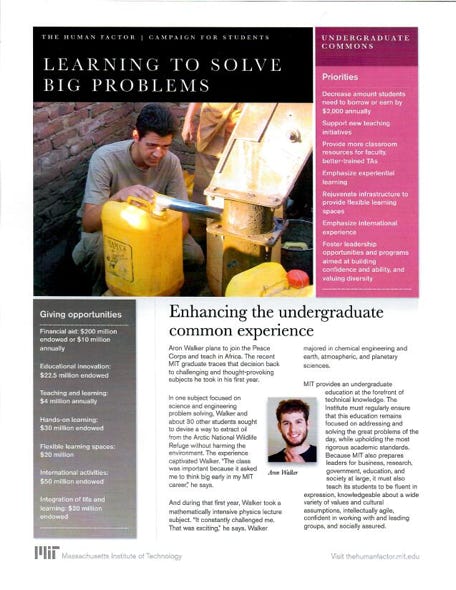
tom witkowski
Learning to solve big problems
Enhancing the undergraduate common experience
Aaron Walker plans to join the Peace Corps and teach in Africa. The recent MIT graduate traces that decision back to challenging and thought-provoking subjects he took in his first year.
In one subject focused on science and engineering problem solving, Walker and about 30 other students sought to devise a way to extract oil from the Arctic national Wildlife Refuge without harming the environment. The experience captivated Walker. “The class was important because it asked me to think big early in my MIT career,” he says.
And during that first year, Walker took a mathematically intensive physics lecture subject. “It constantly challenged me. That was exciting,” he says. Walker majored in chemical engineering and earth, atmospheric, and planetary sciences.
MIT provides an undergraduate education at the forefront of technical knowledge. The Institute must regularly ensure that this education remains focused on addressing and solving the great problems of the day, while upholding the most rigorous academic standards. Because MIT also prepares leaders for business, research, government, education, and society at large, it must also teach its students to be fluent in expression, knowledgeable about variety of values and cultural assumptions, intellectually agile, confident in working with and leading groups, and socially assured.
The MIT Task Force on the Undergraduate Educational Commons recently completed a review of MIT’s “General Institute Requirements”—the foundation in natural sciences, mathematics, technology, humanities, arts, and social sciences that forms the core of an MIT education.
The Task Force report affirms the many ways in which MIT’s common curriculum has successfully prepared graduates for a lifetime of learning and leadership. The report also recognizes that changes in the world today require some very important improvements to the curriculum so that the Institute can offer a broader, more flexible educational experience to prepare MIT students to solve complex, global problems.
The Task Force made recommendations organized arounds four topic areas:
• Providing greater breadth and flexibility in the portions of the first-year undergraduate experience that focus on science and technology, while retaining the rigor that has been the hallmark of these classes. The creation of a new Science, Mathematics, and Engineering Requirement would include project-based experiences—opportunities that involve either design or creation, leveraging real-world problems, to motivate the acquisition of disciplinary knowledge, and stressing the cross-disciplinary interactions needed to address design problems.
• Clarifying and strengthening the general requirements that focus on the humanities, arts, and social sciences, and encouraging more cross-School collaborations that highlight issues at the boundaries of technology and society. First-year students would take an elective that focuses on topics that have attracted great interest in human society and that require multiple perspectives to grasp deeply—such as wealth and poverty, democracy, the self, and war and revolution.
• Encouraging undergraduates to live and work abroad as an essential feature of the undergraduate education, and expanding international programs that have proven successful in the MIT environment. The ultimate goal is to enable any undergraduate who wishes to have a meaningful experience abroad to do so without financial or academic penalty.
• Institutionalizing MIT’s commitment to continued renewal in undergraduate education, and to building and maintaining capacity to continue educational excellence at the undergraduate level. This will be accomplished by improving the quality of classrooms and the mix of classroom types; enhancing advising for students; developing a more unified approach to the first-year experience; reaffirming MIT’s commitment to the racial, ethnic, gender, and class diversity of its students; enhancing the expertise devoted to improving the curriculum and classroom instruction; and broadening the influence of new teaching techniques.
MIT is well positioned to respond to the rapid expansion of knowledge in science and technology, and to the changing demographics and experiences of today’s students. Many of the more promising answers to these educational challenges have evolved at the Institute—the product of individual faculty members, or the collaborative efforts in departments, centers, and laboratories. The task ahead is to nurture the creative impulses that flourish here so that these fledgling initiatives, as well as others that might be developed, will become part of MIT education for all.
Priority program areas
• Financial aid: Additional funding would decrease the amount students borrow or earn by $2,000 annually, making aid levels comparable to those of key competitors.
• Educational innovation: An endowment to fund teaching initiatives might include interdisciplinary or cross-disciplinary subjects, and innovations in teaching and project-based subjects.
• Teaching and learning: MIT constantly seeks better ways to improve instruction. The goals are to provide more classroom resources for faculty, including more and better-trained teaching assistantships, assistance in developing learning objectives, assessment measures for faculty instructional feedback, and course improvements.
• Hands-on learning: Mens et manus—theory and practice, mind and hand—have been the guiding principles of an MIT education. Project-based subjects, UROPs, and internships enhance undergraduate education by enabling students to have a real-world learning experience.
• Flexible learning spaces: MIT is committed to giving faculty and students the facilities they need for their path-breaking work, whether it is done in an academic class or activity. Renovating the infrastructure will provide flexible learning spaces and offer places for community-building.
• International activities: The importance of international experience will be emphasized through student fellowships and support for signature activities such as the MIT International Science and Technology Initiative (MISTI), D-Lab, or similar activities, and exchanges with educational institutions throughout the world.
• Integration of life and learning: Included are leadership opportunities, programs, and experiential learning aimed at building confidence and leadership skills, instilling values and ethics, valuing diversity, self-awareness, and the public policy role scientists are uniquely suited to play.
Giving opportunities
Financial aid: $200 million endowed for $10 million annually
Educational innovation: $22.5 million endowed
Teaching and learning: $4 million annually
Hands-on learning: $30 million endowed
Flexible learning spaces: $20 million
International activities: $50 million endowed
Integration of life and learning: $20 million endowed