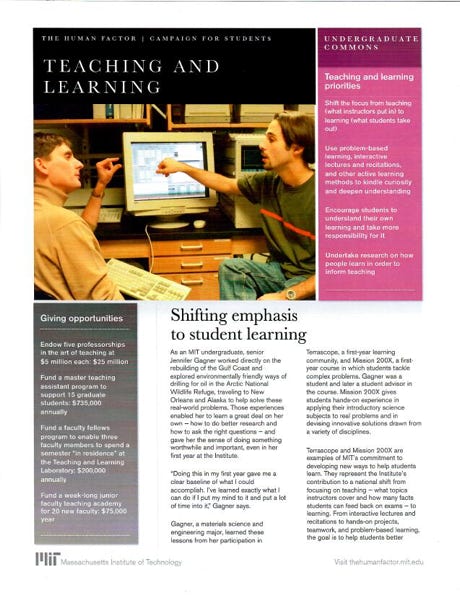
tom witkowski
Teaching and learning
Shifting emphasis to student learning
As an MIT undergraduate, senior Jennifer Gagner worked directly on the rebuilding of the Gulf Coast and explored environmentally friendly ways of drilling for oil in the Arctic National Wildlife Refuge, traveling to New Orleans and Alaska to help solve these real-world problems. Those experiences enabled her to learn a great deal on their own—how to do better research and how to ask the right questions—and gave her the sense of doing something worthwhile and important, even in her first year at the Institute.
“Doing this in my first year gave me a clear baseline of what I could accomplish. I’ve learned exactly what I can do if I put my mind to it and put a lot of time into it,” Gagner says.
Gagner, a materials science and engineering major, learned these lessons from her participation in Terrascope, a first-year learning community, and Mission 200X, a first-year course in which students tackle complex problems. Gagner was a student and later a student advisor in the course. Mission 200X gives students hands-on experience in applying their introductory science subjects to real problems and in devising innovative solutions drawn from a variety of disciplines.
Terrascope and Mission 200X are examples of MIT’s commitment to developing new ways to help students learn. They represent the Institute’s contribution to a national shift from focusing on teaching—what topics instructors cover and how many facts students can feed back on exams—to learning. From interactive lectures and citations to hands-on projects, teamwork, and problem-based learning, the goal is to help students better understand important ideas and master crucial intellectual skills, and to kindle curiosity and excitement.
Developing 21st-century leaders
While lectures continue to be an important instructional method, MIT subjects are also being taught in ways that encourage more active learning. Many courses are project-based, giving students hands-on experiences and fostering and mentoring relationships between students and teachers.
“The faculty member becomes more of a coach in helping students gain the knowledge and abilities the 21st century calls for,” says Lori Breslow, director of the MIT Teaching and Learning Laboratory.
To be tomorrow’s problem solvers and leaders, MIT students must couple their analytical skills with a thorough knowledge of fundamental concepts, an understanding of systems, excellent communications skills, and an ability to identify—and then solve—complex problems, says Breslow. Other examples of how MIT is helping today’s students learn better include:
• WebLab: This online laboratory for the study of microelectronic devices gives students the ability to conduct experiments through the Internet, so they can collect, analyze, and compare data remotely. One of a suite of Internet-enabled laboratories, WebLab enriches science and engineering education by expanding the range of experiments to which students are exposed.
• Small-group teaching: Faculty in the Department of Mechanical Engineering created a series of pedagogical experiments designed to adapt the University of Cambridge’s tutorial system to MIT. In one experiment, students were assigned to work on problems in small groups during recitations; in another, three or four students met with an instructor on a regular basis. Students and faculty were enthusiastic about the experience.
• TEAL: Technology Enabled Active Learning merges lectures, simulations, and hands-on desktop experiments to create a rich, collaborative learning experience. This format is now used for all introductory physics instruction at the Institute.
One of the required physics courses that philosophy senior David Gruber took was in the TEAL format. The course gave him an excellent conceptual understanding of electricity and magnetism, which are fundamental for several engineering fields, largely because of the emphasis on interactive learning and problem solving.
“It offered one-on-one real-time interaction with instructors. It’s all built in,” Gruber says. “In physics, you might be able to explain the concept, but it really becomes concrete when you can solve a problem with it.”
The Teaching and Learning Laboratory has studied the effectiveness of the different pedagogical innovations being used at MIT, and has found that the most successful ones not only strengthen learning, but strengthen students’ ability to retain and transfer the information they learn.
“MIT is improving the learning experience to create graduates who will be able to solve the problems of today and tomorrow,” says Breslow. “Among the improvements envisioned are:
• a faculty fellows program that would enable faculty members to spend a semester in residence at the Teaching and Learning Laboratory, researching best practices, developing innovative curricula, and mentoring junior faculty;
• a junior faculty teaching academy—a week-long course to help new faculty hone their teaching skills, interact with MIT’s best teachers, and discuss research about how students learn and how to put that research into practice in the classroom;
• a master teaching assistant program to support graduate students who have demonstrated exemplary skills in the classroom, and who have a desire to mentor junior colleagues; and
• endowed chairs for the professors in the Art of Teaching whose research would focus on learning, and who would develop world-class innovations in pedagogy, educational technology, and curricula.
Gifts that support innovative teaching at MIT are instrumental in helping Institute students learn better so that they can have the communications and analytical skills, problem-solving abilities, and understanding of science and technology to be the leaders of the 21st century.
Giving opportunities
Endow five professorships in the art of teaching at $5 million each: $25 million
Fund a master teaching assistant program to support 15 graduate students: $735,000 annually
Fund a faculty fellows program to enable three faculty members to spend a semester “in residence” at the Teaching and Learning Laboratory: $200,000 annually
Fund a week-long junior faculty teaching academy for 20 new faculty: $75,000/year