tom witkowski
Unrestricted Gifts Inserts
Need: An annual report to donors of unrestricted funds—gifts that could be used at the Institute’s discretion—about how their gift enabled MIT to fulfill its mission. Previously this was done with a simple letter from the provost.
Solution: Based on the original design of targeted, on-demand materials created by the Office of Communications and Donor Relations, direct mail inserts accompany a letter from the provost and made the connection between unrestricted gifts and specific individuals at the Institute—a new professor and a student.
My role: Developed concept, selected and researched subjects, designed inserts, took photos, and wrote copy.

Unrestricted giving and faculty recruitment
Enabling MIT to attract premier faculty
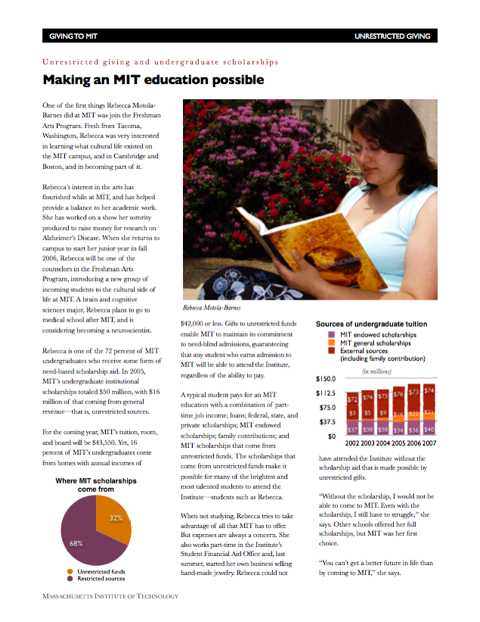
MIT recruited Forest White from a job in the biotechnology industry when the Institute was assembling the faculty for its new biological engineering department.
White, a project manager and group leader with a proteomics company in Virginia, initially had no interest in academia. A chance meeting with Michael Yaffe, an MIT associate professor in biology, and an opportunity to speak to MIT students helped convince White to join the Institute’s faculty.
MIT created its biological engineering major last year—the Institute’s first new major in 29 years. In this field, MIT faculty, students, and researchers use technology from engineering disciplines to understand biological processes at the molecular and cellular level, and eventually to learn how to manipulate those processes. The result will be a better understanding of how cells work, and new ways to treat disease.
The field is highly competitive with many research universities investing in the discipline. When Professor White made the decision to leave a private company, other academic institutions pursued him as well.
“Once I started down the path, I ended up getting interest from a variety of places,” Professor White said. “The amount of money that Stanford, UCSD, Harvard, and Princeton are throwing into this area is significant.”
Professor White realized that doing his research at MIT would be “beyond blue-sky dreams,” he said. The professor’s research involves discovering how and why cells react the way they do to external signals—how a cell decides it is going to grow, move, change gene expression levels, or die.
Over the last three fiscal years, MIT has hired 124 new faculty members Institute-wide. In biological engineering, a new faculty member at the Institute spends much of the first year setting up a laboratory and preparing to start research, as well as teaching. MIT relies heavily on unrestricted funding to cover these startup costs, which include equipment, funding for graduate students, and staff, and salary.
The funding MIT provides a new faculty member in the first year is seed money. The typical startup package, which can total as much as about $1 million, is crucial for launching the research work. Until the junior faculty member and laboratory staff begin to achieve significant results, federal agencies and other outside sources will not provide them with substantial resources. Thus, unrestricted funding aids MIT in its ability to get a new faculty member and his or her lab up and running. And that makes it more likely the professor will successfully attract future research dollars from external sources such as the National Science Foundation, the National Institutes of Health, and private foundations.
Unrestricted giving and undergraduate scholarships
Making an MIT education possible
One of the first things Rebecca Motola-Barnes did at MIT was join the Freshman Arts Program. Fresh from Tacoma, Washington, Rebecca was very interested in learning what cultural life existed on the MIT campus, and in Cambridge and Boston, and in becoming part of it.
Rebecca’s interest in the arts has flourished while at MIT, and has helped provide a balance to her academic work. She has worked on a show her sorority produced to raise money for research on Alzheimer’s Diseases. When she returns to campus to start her junior year in fall 2006, Rebecca will be one of the counselors in the Freshman Arts Program, introducing a new group of incoming students to the cultural side of life at MIT. A brain and cognitive sciences major, Rebecca plans to go to medical school after MIT, and is considering becoming a neuroscientist.
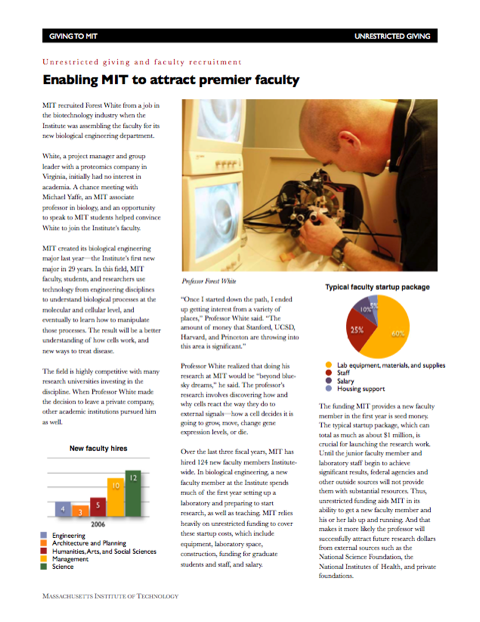
Rebecca is one of 72 percent of MIT undergraduates who receive some form of need-based scholarship aid. In 2005, MIT’s undergraduate institutional scholarships totaled $50 million, with $16 million of that coming from general revenue—that is, unrestricted sources.
For the coming year, MIT’s tuition, room, and board will be $43,550. Yet, 16 percent of MIT’s undergraduates come from homes with annual incomes of $42,000 or less. Gifts to unrestricted funds enable MIT to maintain its commitment to need-blind admissions, guaranteeing that any student who earns admission to MIT will be able to attend the Institute, regardless of their ability to pay.
A typical student pays for an MIT education with a combination of part-time job income; loans, federal, state, and private scholarships; MIT endowed scholarships; family contributions; and MIT scholarships that come from unrestricted funds. The scholarships that come from unrestricted funds make it possible for many of the brightest and most talented students to attend the Institute—students such as Rebecca.
When not studying, Rebecca tries to take advantage of all that MIT has to offer. But expenses are always a concern. She also works part-time in the Institute’s Student Financial Aid Office and, last summer, started her own business selling handmade jewelry. Rebecca could not have attended the Institute without the scholarship aid that is made possible by unrestricted gifts.
“Without the scholarship, I will have to struggle, she says. Other schools offered her full scholarships, but MIT was her first choice.
“You can’t get a better future in life than by coming to MIT,” she says.